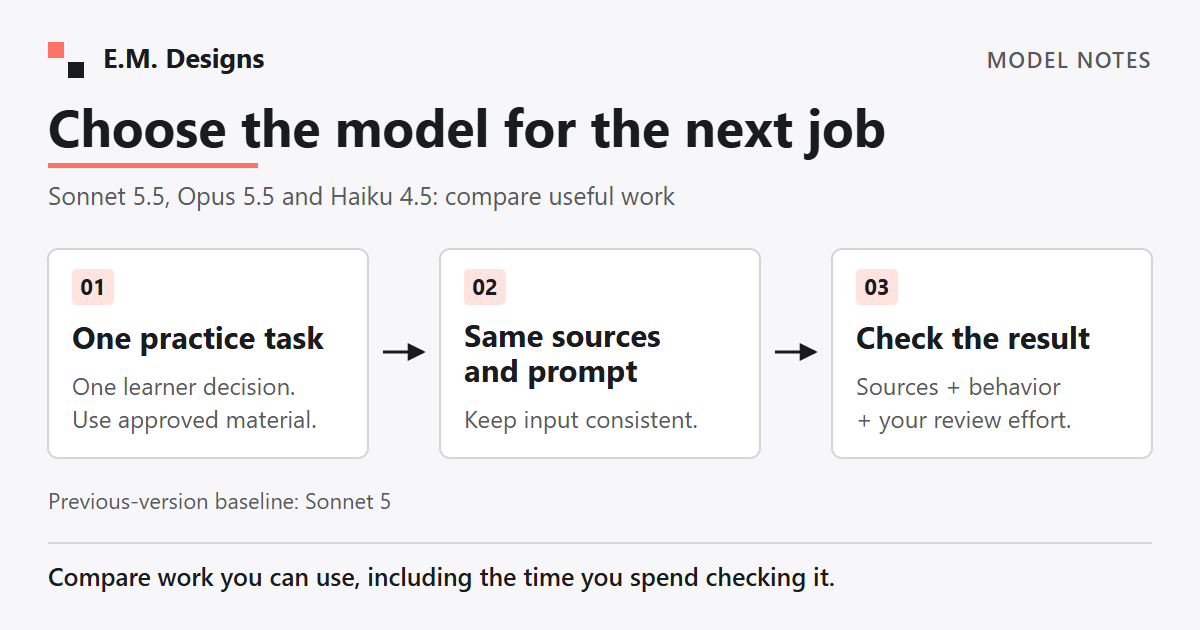
A new Claude model is worth a look when it changes what you can get done in an afternoon. For a learning-game project, that might mean fixing one stubborn interaction, checking a scenario draft or getting a clearer first version of a screen.
Claude Sonnet 5.5 launched on September 28, 2026. Its place in the lineup is everyday work with a clear scope. Anthropic's release notes confirm the launch.
Here is how it compares, why the release matters and a small test you could try. The examples below are proposed uses, not results from a hands-on review.
Why is Sonnet 5.5 having a moment?
Anthropic reports more than 30% faster output generation than Sonnet 5 and up to 30% lower cost per task in its testing. See the announcement and its qualifications.
That combination gives people a useful reason to reconsider their everyday model. Faster feedback matters when you are trying a button, reviewing its behavior and making the next small change.
By “having a moment,” I mean a timely release with a practical improvement to evaluate. This article does not establish a surge in adoption or prove that everyone should switch. A model announcement can earn attention without settling the choice for your project.
How does it compare with the other Claudes?
These three comparisons answer different questions: what changed from the previous Sonnet, when to consider Opus and where a smaller model might fit.
| Model | Input / output per million tokens | A job to evaluate |
|---|---|---|
| Sonnet 5.5 | $2 / $10 | A focused game interaction or scenario draft |
| Sonnet 5 | $2 / $10 | Your existing workflow as a comparison |
| Opus 5.5 | $4 / $20 | A difficult design or architecture decision |
| Haiku 4.5 | $1 / $5 | A small, repeatable sorting task |
Rates are standard Claude API input/output prices checked October 1, 2026, not subscription fees. The suggested jobs are my evaluation ideas. The official pricing page lists caching, batch and other charges separately.
Against Sonnet 5: the advertised savings come from completing work with fewer tokens, not a reduction in those input/output rates. Keep an existing successful task as your baseline before changing a whole workflow.
Against Opus 5.5: a lower input/output rate does not mean every complete task costs half as much. Sonnet and Opus 5.5 both list cache reads at $0.20 per million tokens. Thinking, retries and tool use also affect the bill.
For a learning game, consider Opus when the hard part is deciding how several systems should fit together. Compare Sonnet when the decision is already made and the next change is specific. That is a routing idea to test, not a guarantee of either model's judgment.
Against Haiku 4.5: the current documentation lists Haiku as the fastest of these models, with a 200,000-token context window. Sonnet 5.5 has a one-million-token window. Context is how much material a model can take into a request, not proof that it will notice every important detail. See Haiku's current specifications.
A possible Haiku test is sorting approved scenario notes into a fixed set of categories. Keep ambiguous notes for a person to review. This comparison uses the currently documented Haiku 4.5.
What do the benchmarks actually tell you?
A benchmark tests a particular task under particular conditions. It does not grade your onboarding game, your source policy or the feedback a learner receives.
Effort settings matter, too. Anthropic's launch notes describe a coding evaluation where Sonnet 5.5 scored lower at Max than at Xhigh: extra review activity caused timeouts or changes outside the task. The announcement also flags a fixed pre-release structured-output bug affecting some evaluations. Those details belong beside any headline score. Read the evaluation footnotes.
There is no single leaderboard winner for every learning-design job. Use published results to choose what to test, then judge the actual output against your own acceptance criteria.
What could an instructional designer try?
Start with one learner decision rather than asking for an entire course. For example, supply an approved policy excerpt and ask for three choices with feedback. Require a source reference for each explanation, including why an incorrect choice is incorrect.
Another proposed test is a practice game's feedback screen. Ask for one change that helps the learner understand the consequence of a choice. Keep the scoring and policy untouched so you can judge that change on its own.
For a small business, try turning fictional discovery notes into a draft game brief: audience, workplace decision, source material needed and questions for the content owner. A polished brief is still a draft. It does not confirm a client's policy or promise a learning result.
What prompt gives you a useful comparison?
Use the same approved practice material and prompt for each model:
A prompt you can adapt
Use the approved practice content I provide. Draft one workplace decision with three choices and feedback. Cite the source for each choice and explanation. Separate fictional scene details from policy. Flag missing or conflicting rules instead of filling the gaps. Return the draft and a short review checklist. Do not edit source files, send, publish, delete, overwrite important files, spend money or access other projects.
Before running it, save a checkpoint or work in a copy. Keep permission checks on and use fictional or explicitly approved material. A prompt is not a replacement for your tool permissions or your organization's data rules.
Check whether you can follow every reference, whether the learner practices the intended decision and how much correction the draft needs. Record the model, effort setting, elapsed time and any metered cost. Compare useful completed work, including your review time, rather than response length alone.
What should you check before switching?
Developers can use claude-sonnet-5-5 through the Claude API and supported cloud platforms. The model documentation lists a one-million-token context window and a standard maximum output of 128,000 tokens. Those are API capabilities, not an unlimited-use promise for your plan. Check current availability and specifications.
Claude Code defaults to Medium effort for Sonnet 5.5; the Claude API defaults to High. Your saved settings can affect a Code session. Check the model configuration and API effort guide. Record the actual setting when comparing outputs.
Claude Code requires version 2.1.284 or later for Sonnet 5.5. Provider aliases can point to older models, so confirm the full model name rather than assuming “sonnet” means the new release.
If you maintain an API integration, changing the model ID alone may break it. Sonnet 5.5 changes thinking controls and rejects forced tool selection. Test the migration in a separate environment before replacing a working connection. Use the official migration guide.
The useful question is whether this model helps you build and check the next meaningful piece of your game. A better draft still needs accurate content, clear feedback and a person willing to play it.
Want to Build a Learning Game for Your Team?
Bring a workplace decision your people need to practice. We can explore how to turn your team's learning content into a playable game, with the content and feedback checked along the way.
Explore game-building for your team